← The Signal · #236 · August 2026
What a Queue Is Really Selling
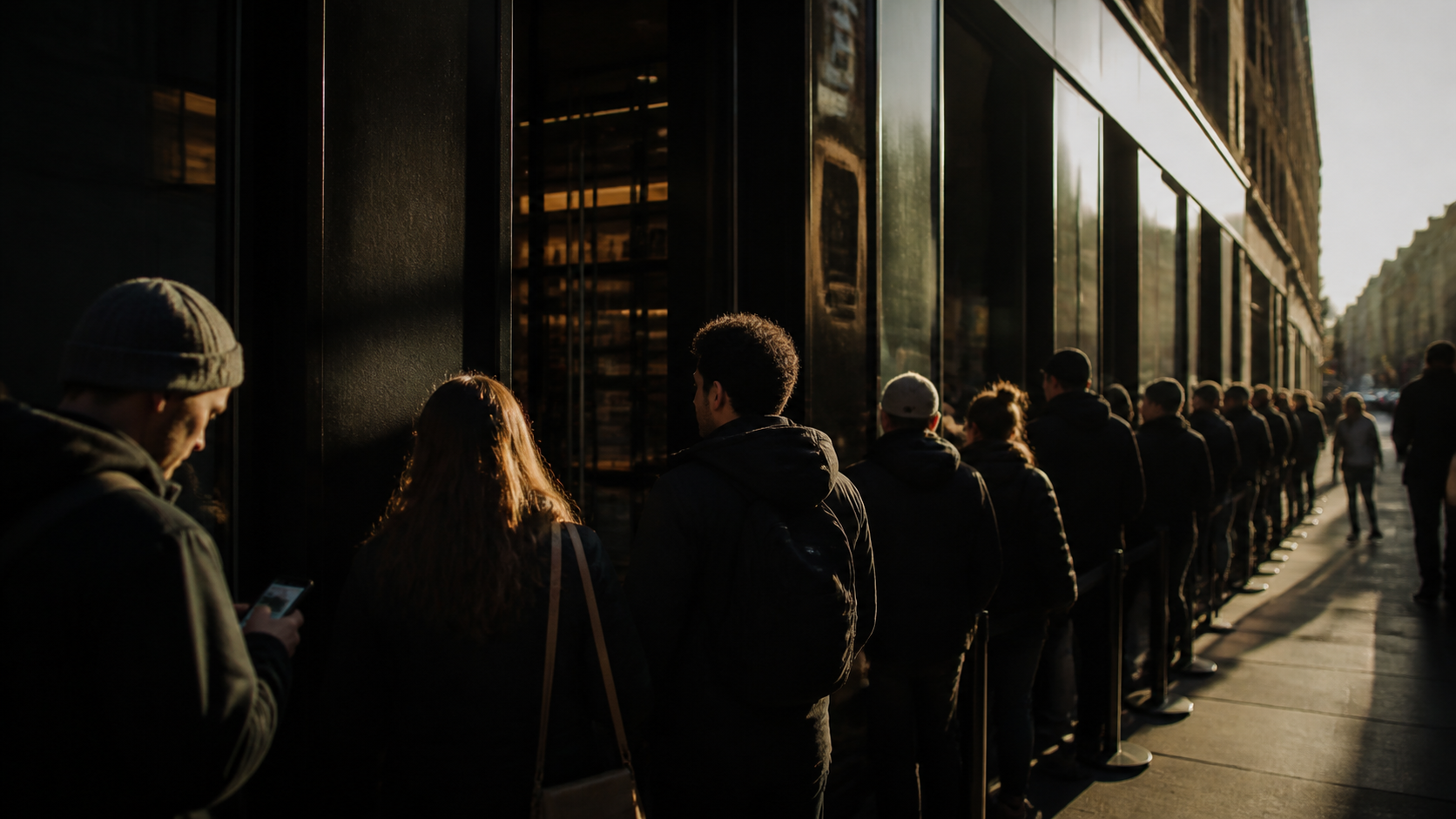
A visible queue can make a business seem more desirable. But the real commercial value is not scarcity. It is the confidence a well-handled wait gives the next customer.
What a Queue Is Really Selling
I have been thinking about queues lately. Not the irritating kind: the silent line outside a restaurant, the fully booked calendar, the product that is briefly hard to get hold of.
We are taught to remove friction. Usually, that is sensible. Make it easier to buy, easier to understand, easier to return. But some forms of friction do something more complicated. They make demand visible.
That visibility changes the decision for the person still standing outside.
Waiting can lend a choice confidence
Behavioural economics has long described the effect of social proof: when a decision is uncertain, people look to other people for evidence. A queue is unusually efficient evidence. It does not ask a customer to believe a claim. It lets them observe a choice being made.
That is why a full restaurant can feel safer than an empty one, even when both have the same menu. The queue is not simply an inconvenience. It is a public signal that other people judged the experience worth their time.
But there is an important distinction. A queue does not create value by itself. It can only reveal value that is already there. Manufactured scarcity without a rewarding experience turns anticipation into resentment remarkably quickly.
Dishoom understands the difference
Dishoom has made the wait part of the hospitality rather than an administrative failure. At many of its restaurants, guests waiting for a table are offered chai and a sense of occasion before they sit down. The line still communicates demand, but the business does not leave people alone with the cost of that demand.
That matters commercially. The wait becomes a threshold into a world with its own rituals, not dead time before the transaction. It gives prospective guests two reasons to stay: other people appear to want this, and the business appears to care while they decide.
Many companies copy only the first half. They limit access, create a waitlist, announce a drop, or make a sales conversation unnecessarily difficult. They hope scarcity will make them desirable. What they often create is doubt.
Demand is persuasive when it looks like a consequence, not a tactic.
The useful question is not how to add friction
It is where your business already creates proof that no advertisement could supply.
A specialist firm may have a thoughtful consultation process that shows the seriousness of its work. A retailer may have a small but distinctive in-store ritual. A software company may have customers who visibly recommend it to peers. These are not bottlenecks to be polished away automatically. They are moments where customers can see that the choice has meaning.
The job is to protect the signal while reducing needless anxiety around it. Explain the wait. Make the next step clear. Give people something useful, generous or memorable while they are deciding.
- Identify the point where customers can see others choosing you.
- Ask whether that moment creates confidence or merely inconvenience.
- Improve the experience around it before trying to manufacture more demand.
Dishoom is a useful reminder that people do not always want instant access. Often, they want reassurance that their time and money are being placed well.
The question is not whether your customers ever have to wait. It is what they learn about you while they do.