← The Signal · #232 · August 2026
A Queue Is Part of the Product
Costco shows that convenience is not always the route to confidence. Sometimes a little effort makes a promise more believable, a choice easier and a customer more willing to return.
A Queue Is Part of the Product
Most customer journeys are designed around a simple assumption: any effort is a defect.
Shorten the form. Remove the wait. Add more choice. Make the purchase disappear into a tap.
Much of this is sensible. Needless effort is expensive. It gives people time to reconsider, compare and leave.
But there is a useful distinction that gets lost in the rush towards frictionlessness. Some effort is waste. Some effort is reassurance.
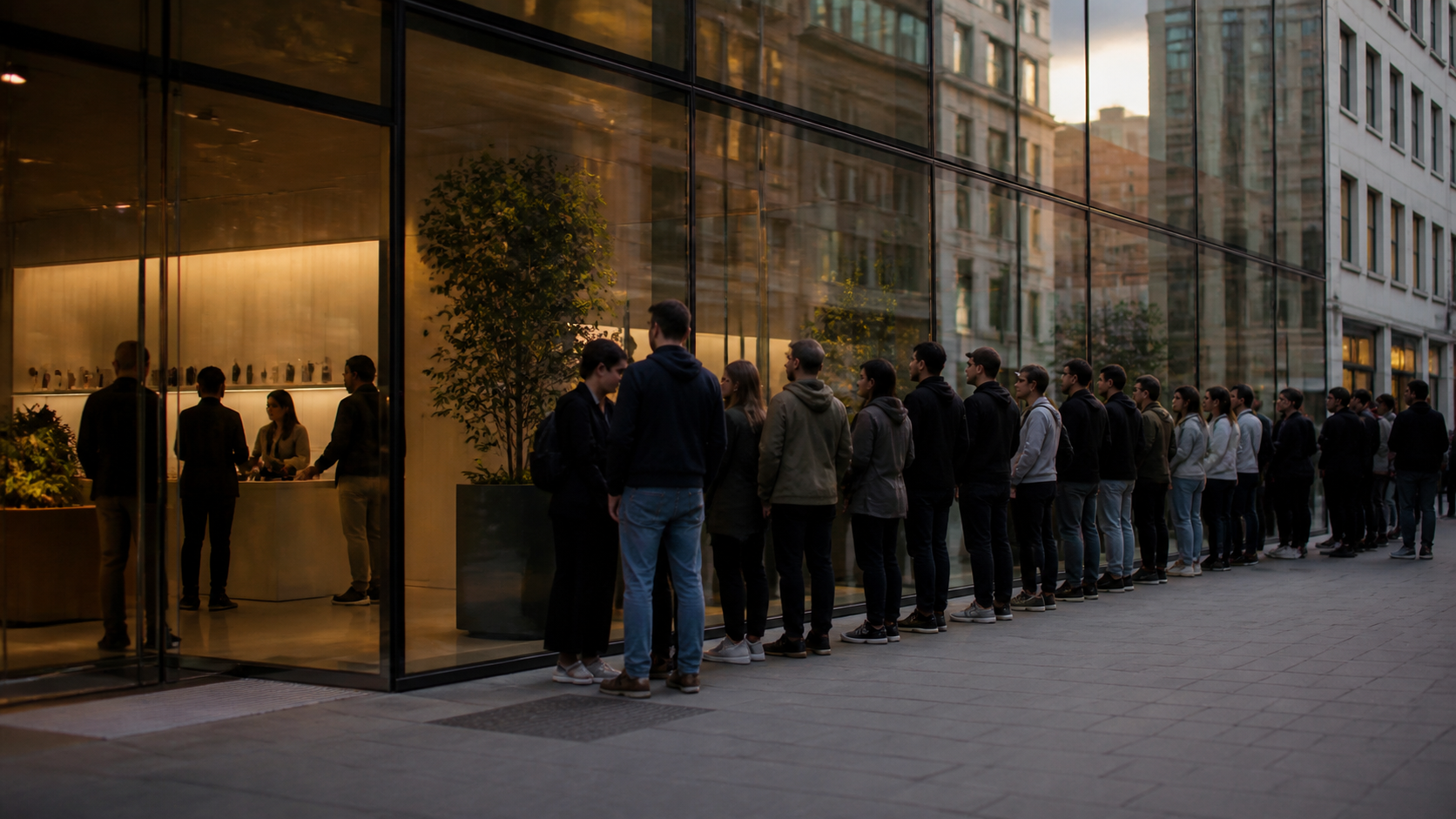
A queue outside a good restaurant does not usually make the restaurant less desirable. It makes demand visible. A membership fee can do something similar. It asks customers to make a small commitment, then gives the business a reason to keep earning it.
Choice has a hidden cost
Behavioural economics has long challenged the comforting idea that more options always help people. Every extra option creates work: comparison, doubt and the fear of choosing badly.
This matters because customers rarely experience a category as a strategist does. They do not admire its abundance. They feel its effort.
The commercial question is not simply how to remove steps. It is how to remove uncertainty. Those are different jobs.
A business can make buying technically easy while making the decision emotionally difficult. Endless plans, feature lists, product variants and promotional claims can all produce that result. The customer has fewer barriers, but less confidence.
Costco makes commitment do the work
Costco is an unusually clear example. Before a customer can routinely buy, they join. The annual membership is an apparent obstacle in a retail world trained to prize immediate access.
Yet it changes the relationship. The warehouse is not trying to be every shop for every occasion. Its comparatively narrow assortment says that much of the selection work has already been done. The membership says this is a place worth planning for. The busy checkout says other people believe it too.
None of this is luxurious convenience. It is a coherent set of signals. The customer is asked for a little effort, but receives a stronger promise in return: value here has been actively negotiated, selected and protected.
That is why the queue is part of the product. Not because waiting is inherently good, but because it can make an otherwise invisible proposition tangible.
Explore Costco's membership model
Do not confuse friction with proof
This is not an argument for making customers work harder. A confusing checkout is not premium. An unanswered sales enquiry is not exclusivity. A difficult website is not confidence.
Meaningful friction earns its place by clarifying the exchange. It can signal care, curation, demand, expertise or mutual commitment. Waste friction does none of these things. It merely transfers operational inconvenience to the customer.
The test is simple: if you removed this step, would the promise become clearer or thinner?
One practical move
Find the moment where a prospect has to decide whether you are worth trusting. Then make one proof of your judgement more visible there.
- A specialist firm could show what it deliberately refuses to do.
- A software business could simplify its packages around the decision a buyer is trying to make.
- A retailer could make its selection criteria explicit, rather than expanding the range.
Do not add ceremony for its own sake. Make the right commitment feel safer.
The businesses that win trust are not always the ones that make everything effortless. They are often the ones that make the important choice feel already considered.
Where might a little more commitment make your promise more believable?